
HereWeGo
April 2, 2026 • 6 min read
I felt a wave of excitement as I approached the address in Kakinokizaka. The Japanese tea ceremony has long been on my bucket list, and now that moment had finally arrived. However, I was unsure of what to expect. Known as chanoyu (or sado/chado), I had only a vague understanding of the ceremony. I
```html
Experiencing the Art of Tea in Tokyo: A Morning in Japan
I felt a wave of excitement as I approached the address in Kakinokizaka. The Japanese tea ceremony has long been on my bucket list, and now that moment had finally arrived. However, I was unsure of what to expect. Known as chanoyu (or sado/chado), I had only a vague understanding of the ceremony. I knew it was a formal ritual with a clear structure, deeply rooted in tradition and accompanied by specific practices. In Japan, there is an unspoken expectation to adhere carefully to the rules. Despite my best efforts to pay attention, even unintentional mistakes could lead to disappointment. As someone who tends to overthink, I was anxious about making errors and embarrassing myself, especially in such a formal setting. But now, there was no turning back; this was my opportunity to learn, and I was determined not to let my worries take over. Taking a deep breath, I rang the bell and waited to be invited in.
The Tea Ceremony in Tokyo
Tokyo offers a variety of fascinating tea ceremony experiences to make your visit truly special. Some options include: a private tea ceremony in a tea room, a tea ceremony paired with a Kaiseki lunch at a traditional restaurant, a private cha-kai dinner with personalized cocktails in a special tea room, and learning to make traditional sweets from a professor of the Bifu school. Among these, the Sencha tea ceremony stands out prominently.
The Purpose of the Japanese Tea Ceremony
For many in the West, enjoying tea is often a social experience. For instance, an English tea party is an occasion to gather and enjoy delicious treats. However, the tea ceremony in Japan is entirely different. The aim is not just to drink tea, but to cultivate presence. Heavily influenced by Zen Buddhism, the tea ceremony encourages both host and guest to set aside the hustle and bustle of daily life to savor each shared moment. Every gesture in the ritual holds meaning—from how the tea is whisked to how the cup is held. These actions are not meant to impress but to focus attention. In a world that constantly pulls us in various directions, the tea ceremony creates a rare space where nothing is rushed or wasted. Time seems to stand still, and the act of preparing tea becomes a form of quiet meditation.
Experiencing a Serene Morning in Tokyo
I participated in a tea ceremony at To-Ri-An, an Urasenke school located in Meguro, Tokyo. This is one of the three largest tea schools in Japan. To-Ri-An is run by a couple, Souei Funakoshi and Souai Kawada. I was prepared to meet a translator, but both professors were fluent in English. Souei-san welcomed me at the door and guided me into the tea room, where I sat in front of the tokonoma (the alcove). Souai-san explained that the tokonoma is the spiritual heart of the tea room, showcasing a kakemono (hanging scroll) and chabana (simple flower arrangement).
Each season brings changes to the tea ceremony. The hanging scroll often reflects the season in which it is displayed. In my tea ceremony, the scroll chosen depicted a famous Taoist story titled "The Lost Horse." This powerful tale reminds us to accept the world as it is. I attended To-Ri-An at the end of winter, and the tsubaki (camellia) flowers were used in that day's arrangement. This flower blooms from late winter to early spring and is often used in tea ceremonies during the colder months.
✈️ Tìm chuyến bay giá tốt
Đặt vé ngay với giá ưu đãi từ các hãng hàng không
Subtle Actions in the Tea Ceremony
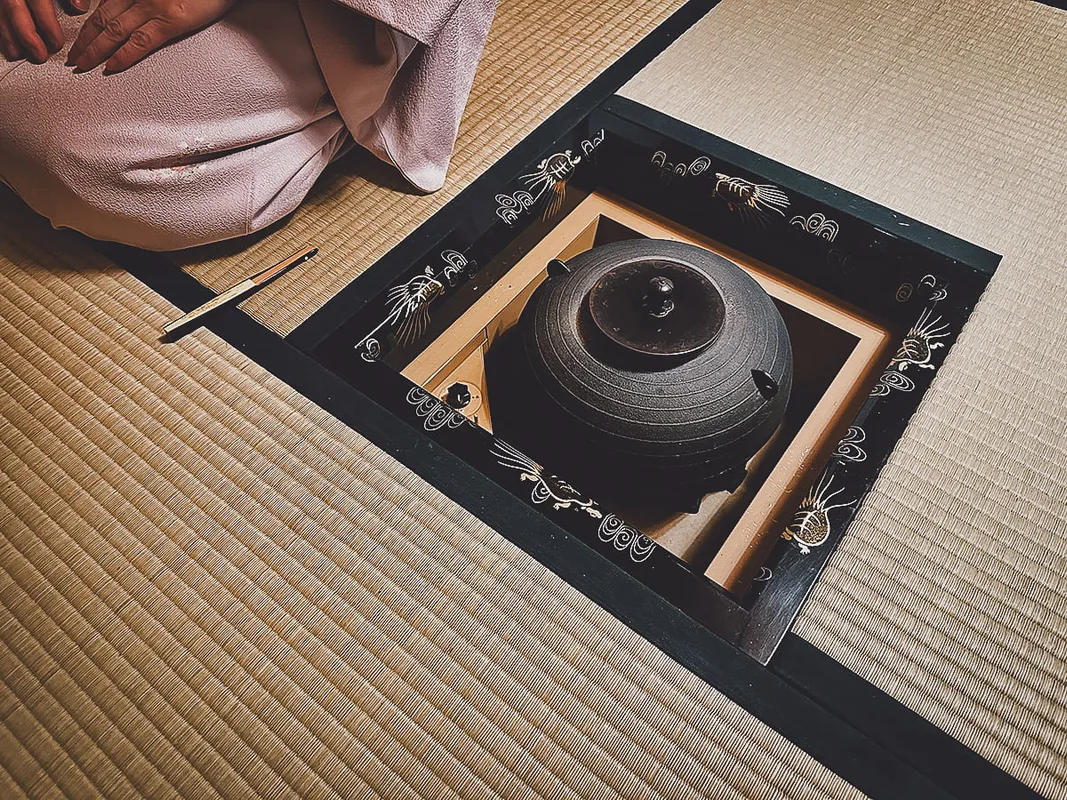
Inside the tea room, a hearth is designed for boiling water for the tea. This hearth is typically used in winter, while a portable stove is used in summer. Souai-san showed me the tana, a small stand for placing the utensils. On it was a small tea box, and underneath was a mizusashi—a large vessel for cold water used to refill the kama and to rinse the utensils used in the ceremony. Souai-san opened the tea box and showed me the inscription inside the lid, which bore the name of the tea master as a mark of quality for the matcha.
Souai-san guided me on how to sit properly. The traditional Japanese sitting posture is called seiza—sitting on your heels with your legs tucked underneath. If you're not accustomed to this position, it can be quite challenging and somewhat uncomfortable. I tried to endure the discomfort to impress the masters, but I also knew that the Urasenke school allows guests to sit on chairs. This is one of the differences between Urasenke and other schools like Omotesenke or Mushanokoujisenke.
Tea Ceremony and Culture
As soon as Souei-san entered the room with a plate of wagashi—a type of traditional Japanese sweet—the tea ceremony officially began. I had enjoyed matcha and wagashi many times in Japanese gardens, but no one had ever told me that you should eat wagashi before drinking tea. The strong, grassy flavor of matcha can be overwhelming for some, so wagashi is typically used to soften the bitterness of the tea. There are many types of wagashi, with the most beautiful being nerikiri—a handmade sweet made from white bean paste. This particular sweet is crafted to resemble a leaf, perhaps symbolizing the arrival of spring.
From the moment Souei-san entered the room, you could sense that the tea ceremony carries a much more serious tone than Western tea culture. First and foremost, there is almost no conversation. Long silences pass, and anything that is said is part of the ritual. This is entirely intentional. When there is no chatter to distract you, your focus shifts to other elements—from how Souei-san cleans the utensils to the sound of boiling water in the kettle, and to the precise movements unfolding before you.
In the Japanese tea ceremony, every action must be precise; nothing is spontaneous, not even the way Souei-san folds the cloth or the angle at which the ladle is held. This meticulousness, combined with mastery of the ritual and mindful presence, is why it takes years, even decades, to become a tea master.
```
HereWeGo
HereWeGo is a leading online flight booking platform in Vietnam, providing accurate and up-to-date travel information. We are committed to delivering wonderful travel experiences with the best prices on the market.