
HereWeGo
May 17, 2026 • 3 min read
This article explores Emirates' decision to discontinue its 615-seat A380 flights in favor of a three-class configuration and the implications of this change for the aviation industry.
Introducing Emirates' 615-Seat A380
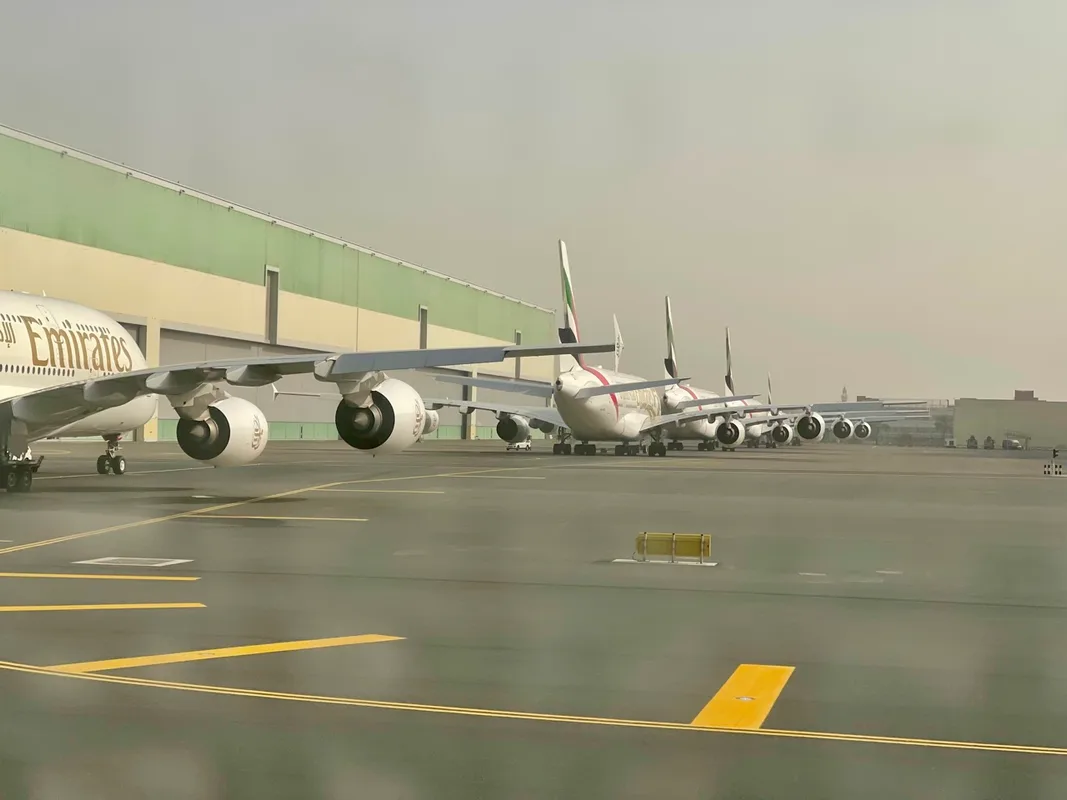
Once hailed as a marvel of the aviation world, Emirates' 615-seat A380 was the epitome of capacity on a commercial flight. However, the airline has made the decision to remove 46 seats from this version, transitioning to a three-class configuration.
Why Did Emirates Decide to Change?
For the past two decades, Emirates has operated two configurations of the A380. The most popular version features 14 First Class suites, 76 Business Class seats, and a spacious Economy section, totaling between 489 to 517 seats depending on adjustments. On the other hand, the lesser-known version offers two classes: 58 Business Class and 557 Economy seats, bringing the total to 615 — making it the largest commercial aircraft in operation today.
This configuration primarily served price-sensitive routes like Bangkok, Bali, and Kuala Lumpur, where the airline could optimize profits by maximizing passenger capacity. While this model has been stable for two decades, it seems to have lost its effectiveness.
Details on the New Adjustment
In February, Emirates announced that it would convert all 15 of its two-class A380s into a three-class layout: 76 Business Class, 56 Premium Economy, and 437 Economy seats, for a total of 569 seats. This means the airline is voluntarily removing 46 seats to optimize revenue per square meter instead of just maximizing the number of seats.
Ticket prices for Premium Economy on flights from Dubai to Bangkok or Mauritius can be two to three times higher than Economy seats in the same row. However, the Premium Economy seating occupies about 1.4 times the floor space compared to Economy. As a result, revenue per square meter increases, even though the total number of seats decreases.
✈️ Tìm chuyến bay giá tốt
Đặt vé ngay với giá ưu đãi từ các hãng hàng không
Emirates' Market Strategy
Emirates has realized that the shift towards premium seating is not just a trend in the North Atlantic but is becoming a global demand. Premium Economy is gaining popularity, resembling First Class on domestic flights and featuring a separate cabin rather than being situated at the front of the Economy section.
Implementation Timeline and Trial Flights
The first modified aircraft operated on the Dubai-Amman route from April 14 to May 31. Following this, Emirates will begin deploying the new configuration on the Dubai-Prague route starting June 1, followed by Dubai-Guangzhou in October. The full conversion of the 15 aircraft is expected to be completed by November.
The Dubai-Amman route was chosen for this trial not only due to its short duration of about 3.5 hours but also because it has a significant mix of business and leisure travelers. If all goes well, Emirates plans to expand this configuration to more routes, showcasing a robust transformation within the airline.
Global Premium Economy Trends
In recent years, Premium Economy has evolved from a trial product to a key structural component of airline cabins. Emirates is not the only airline making these enhancements; Singapore Airlines, Japan Airlines, and Virgin Atlantic are also undertaking similar upgrades on their A350 and 787 aircraft.
Conclusion
The decision to discontinue the 615-seat A380 configuration is not just an internal change for Emirates but reflects a new philosophy in the airline industry. The abandonment of the goal to carry the maximum number of passengers is being replaced by the focus on optimizing revenue per square meter. This may signal a stronger shift in the aviation industry towards providing more valuable experiences for passengers in the future.
Article adapted and referenced from: Live and Let's Fly
HereWeGo
HereWeGo is a leading online flight booking platform in Vietnam, providing accurate and up-to-date travel information. We are committed to delivering wonderful travel experiences with the best prices on the market.